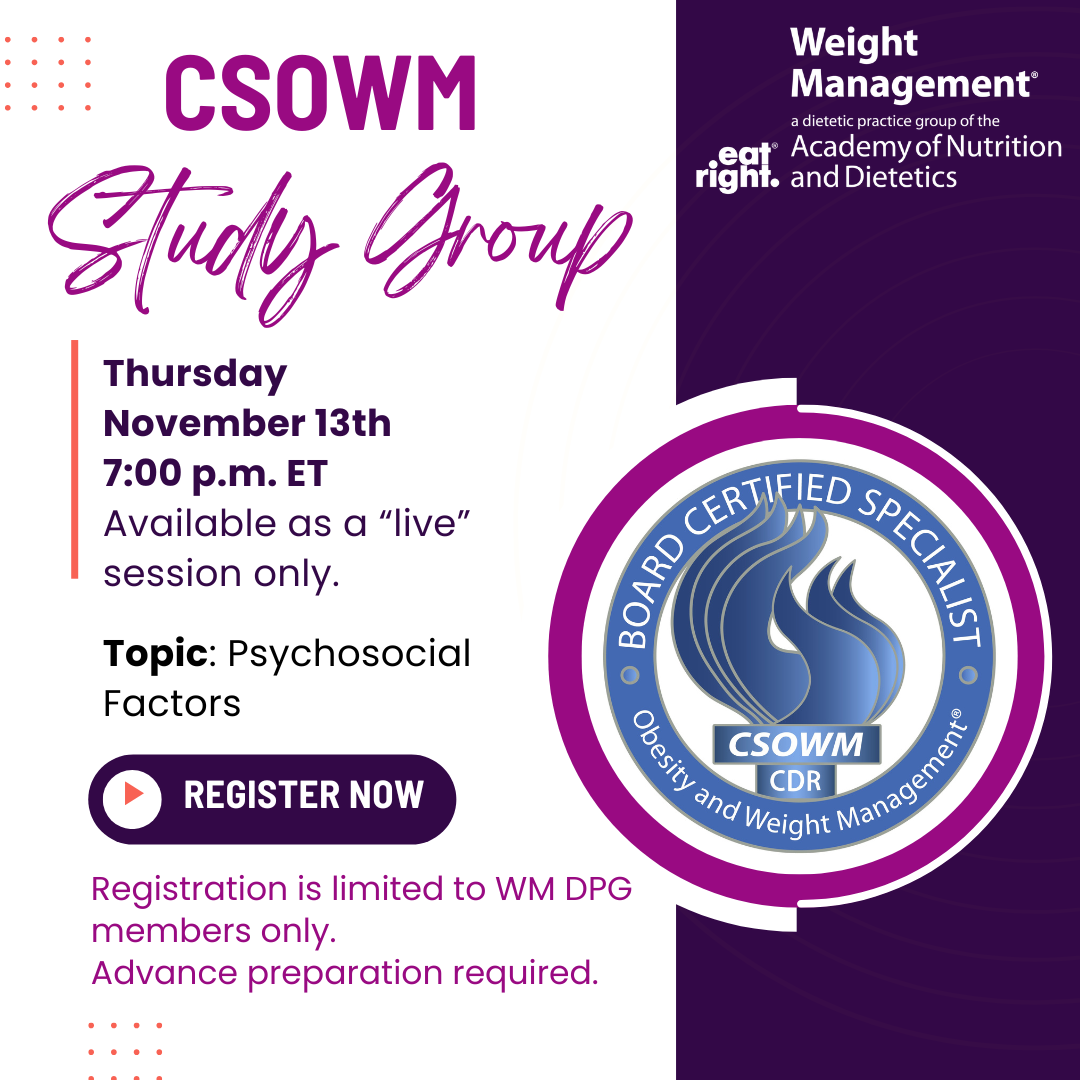
Register in advance here.
We'll be discussing the following articles (be sure and review in advance):
Behavioral Treatment of Obesity: Butryn ML, Webb V, and Wadden TA. Psychiatr Clin North Am. 2011; 34(4); 841-859.
Position of the Academy of Nutrition and Dietetics: Medical Nutrition Therapy Behavioral Interventions Provided by Dietitians for Adults With Overweight or Obesity, 2024: J Acad Nutr Diet. 2024;124(3):408-415.
Position of the Academy of Nutrition and Dietetics: Interventions for the Treatment of Overweight and Obesity in Adults. J Acad Nutr Diet. 2016; 116:129-147.
Weight Management Interventions Provided by a Dietitian for Adults with Overweight or Obesity: An Evidence Analysis Center Systematic Review and Meta-Analysis. J Acad Nutr Diet. 2023
Please review the guardrails and information regarding the study group here.
Discussion questions for this session:
Behavioral treatment of obesity (Foster, Makris, Bailer, 2005):
- How does the concept of "cognitive therapy," as described in this article, address psychosocial factors in obesity treatment, particularly regarding negative thoughts and feelings?
- How do weight bias and "empathic encounters" directly impact a patient's engagement and adherence to a weight management program?
- How can understanding the "behavior chain" tool assist RDs in addressing the psychological triggers for overeating or inactivity?
Weight Management Interventions Provided by a Dietitian (Morgan-Bathke et al., 2023)
- How might an RD tailor their approach to a client who is in the "contemplation" stage versus one in the "action" stage for weight management?
- What specific psychosocial aspects of QoL might be positively impacted by RD led interventions, and why is this a crucial outcome beyond weight loss?
- The review notes that interventions with at least five contacts and a duration of at least one year were generally more efficacious. From a psychosocial perspective, why might this intensity and duration be particularly important for sustained behavior change in weight management?
Academy Position Paper Obesity 2016 (Raynor & Champagne, 2016)
1. Why is assessing motivation, readiness for change and self-efficacy critical before prescribing specific dietary or activity interventions?
2. How do Cognitive Behavioral Therapy (CBT) and Motivational Interviewing (MI) differ in their primary focus on psychosocial factors?
3. How does understanding the “hedonic system” inform an RD's approach to dietary counseling, especially when environmental cues encourage overconsumption?
Academy Position Paper Obesity 2024 (Raynor et al., 2024)
1. From a psychosocial perspective, what are the potential negative impacts of weight bias on a client's mental health and engagement in MNT?
2. How does using an approach of “cultural humility” address psychosocial factors more effectively than a generic, one-size-fits-all intervention?
3. What is the likely psychosocial mechanism by which MNT behavioral interventions contribute to improved mental well-being, even beyond direct weight loss?