March 2026 - Amy Bollam, RD, LD, MPS
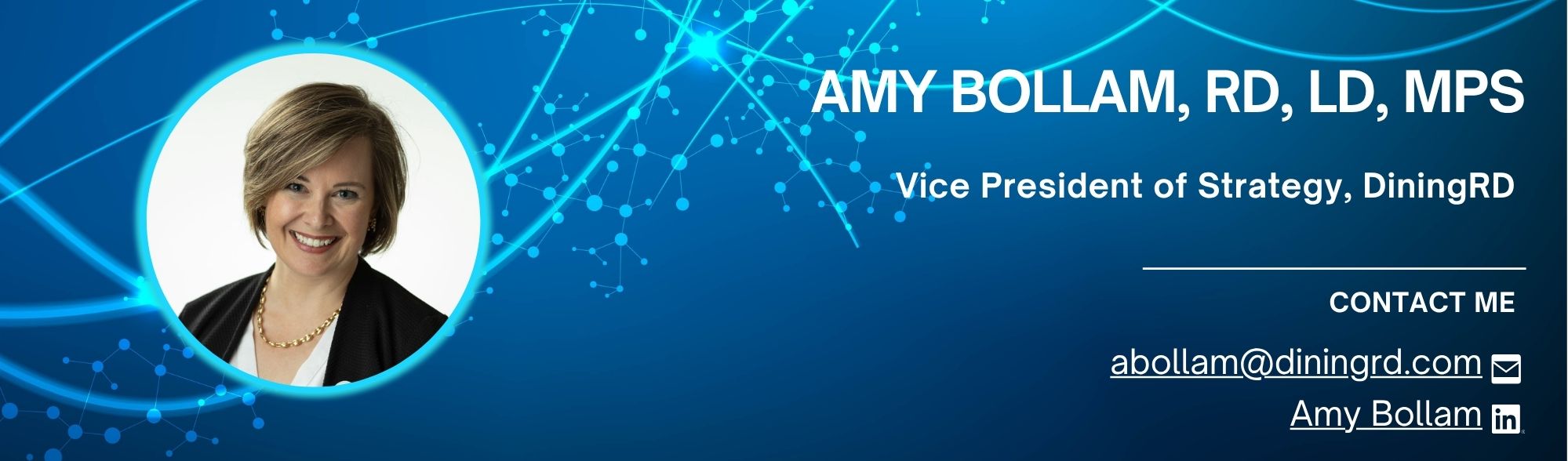
Getting Started with Amy Bollam
What was your first job as an RD?
My first role as a Registered Dietitian was with Aramark, where I worked as a Clinical RD and provided oversight of the diet office. That early experience—balancing clinical needs, patient safety, tray accuracy, and workflow coordination—gave me invaluable insight into how essential well-designed systems are to supporting nutrition care.
How did you first get into Nutrition Informatics? What sparked your interest?
My interest began when I realized just how much time dietitians spend navigating inefficient systems—manual diet office processes, menu errors, redundant documentation, and disjointed communication. I saw technology as a path to remove these barriers. The opportunity to build or refine tools that improve accuracy, reduce workload, and elevate nutrition care is what initially sparked my passion for informatics.
What education or training helped you most?
My degrees in Dietetics and Nutrition established the clinical foundation, while my Master’s in Human Resources strengthened my skills in leadership, organizational strategy, and change management. Additional training in workflow analysis, health IT, and foodservice systems helped me understand how to transform nutrition workflows through technology.
What was your biggest challenge breaking in, and how did you overcome it?
One of the earliest challenges was learning how to communicate effectively with software developers and technical teams. I overcame this by becoming a bridge—learning the basics of development, APIs, and system design so I could advocate for realistic, user-friendly solutions that align with the needs of dietitians and foodservice operators.
Day-to-Day & Key Skills
What is your current role?
I serve as the Vice President of Strategy for DiningRD, guiding strategic initiatives, product evolution, partnerships, and long-term planning for our nutrition and foodservice technology solutions.
What does a typical day look like for you?
My days blend strategy, collaboration, and problem-solving. I work with product and development teams on enhancements, meet with customers and partners to understand their operational needs, review market trends, and help ensure our technology supports regulatory compliance, workflow efficiency, and a high-quality dining experience for older adults.
Must-have technical skills (software/tools):
Understanding EMRs, menu systems, and integration pathways
Data analysis and dashboard interpretation
Workflow mapping and process design
Basic understanding of APIs and interoperability
Strong knowledge of regulatory requirements that influence nutrition documentation and menu management
Beyond tech, what other skills are essential in this field?
Change management
Clear communication and cross-functional collaboration
Systems thinking
Problem-solving and adaptability
Ability to translate nutrition and workflow needs into technical direction
Has AI impacted your day-to-day work? If so, how?
Yes—AI plays a major role in how I brainstorm, analyze data, and evaluate solutions. It accelerates early-stage content creation, supports predictive insights for operations, helps refine ideas, and enables more efficient strategic planning. AI has also become a valuable tool within our industry, improving menu personalization, forecasting, and workflow automation.
Resources and Tips
What resources do you swear by for learning?
I rely on a blend of nutrition, technology, and industry-focused resources to stay current. Throughout the year, I participate in webinars on AI, workflow automation, and data-driven care, and I routinely take courses that strengthen my skills in data literacy, analytics, and API fundamentals. Because my work sits at the intersection of nutrition, healthcare, and foodservice, I also follow restaurant and consumer dining trend data from groups like Datassential, which provide valuable insights into menu innovation and generational preferences. Industry conferences across senior living, healthcare technology, and foodservice innovation round out my learning and help me stay connected to broader trends shaping the future of dining and nutrition care.
What’s one key tip for someone trying to get into Nutrition Informatics?
Start by observing inefficiencies in your daily workflow—those pain points are often where informatics has the greatest impact. You don’t need to be a developer; you just need curiosity and a desire to build better systems.
How do you stay updated on the latest trends?
I follow AI and health tech leaders, attend webinars, read industry publications, and stay connected with interdisciplinary colleagues who are shaping innovation in aging services and healthcare.
Favorite AI tools, tips, or tricks?
I use generative AI for brainstorming, data interpretation, workflow analysis, and early-stage drafting. My biggest tip: treat AI as a thought partner, but always apply your professional judgment. Learning basic prompt engineering also goes a long way.
Has the NI DPG been helpful on your journey? If so, how?
Absolutely—the community, resources, and thought leadership have helped broaden my perspective on the role dietitians can play in shaping technology.
The Impact
What do you find most rewarding about working in nutrition informatics?
I love seeing technology remove barriers for dietitians and foodservice operators. When a system reduces stress, increases accuracy, and ultimately improves care for patients or residents, it reinforces why informatics is so important.
Can you share a project you’re proud of and its impact?
One project I’m especially proud of is the evolution of DiningRD’s Tableside solution, which has grown significantly since its inception more than ten years ago. The idea for Tableside was inspired by my early experience in acute care, where I watched room service dining transform the patient experience through personalization, efficiency, and choice. I became passionate about bringing that same level of innovation to senior living and post-acute care—settings where dining has an equally profound impact on wellbeing and satisfaction. From the start, our focus has been balancing meaningful technological advancement with an intuitive, user-friendly design. Today, Tableside has evolved into a robust platform that enhances resident choice, improves order accuracy, strengthens communication across care teams, and streamlines the workflow for operators. Seeing how this tool has empowered staff, reduced errors, and elevated the dining experience across hundreds of communities has been incredibly rewarding, and it continues to guide how we design technology with both innovation and usability at the forefront.